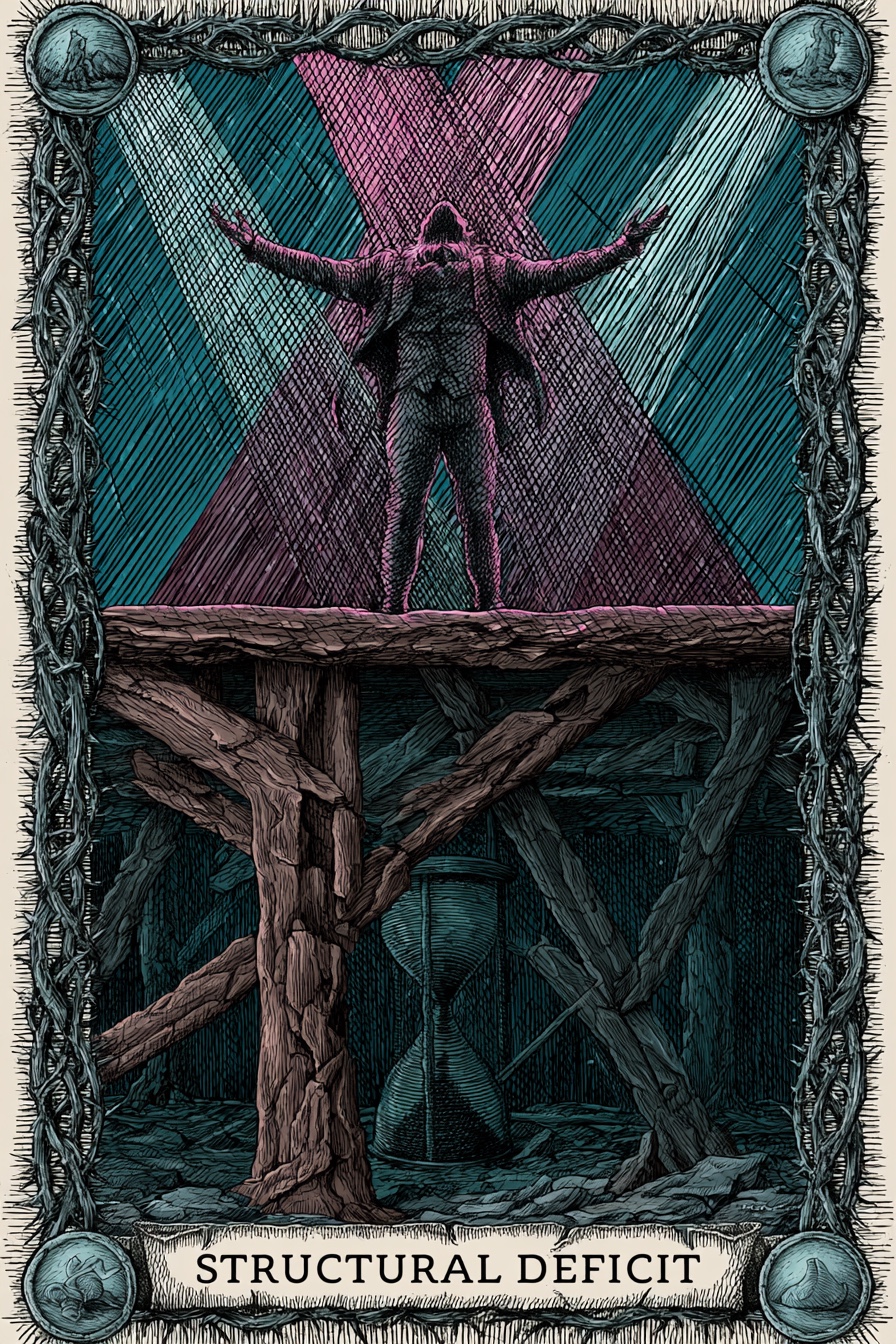
Structural Deficit
What does this mean?
Persistently low financial health over 5 years despite strong programmatic output. They are borrowing from their future (or bleeding an endowment) to pay for today's programs.
The Path Forward
The Truth-Teller
Forces necessary, painful cuts to preserve the core. It demands that the organization stop borrowing from its future and align its current programmatic output with actual sustainable revenue.
Title
Representative Institutions
Institutional Epochs
Historical Performance
| Year | Revenue | Top Comp | Comp % Rev | Score | Phase Label | Outlook | Details |
|---|---|---|---|---|---|---|---|
| 2023 | — | — | 11.1% | 42 | Financially Distressed | Recovery | |
| 2022 | — | — | 6.7% | 38 | Financially Distressed | Recovery | |
| 2021 | — | — | 17.1% | 29 | Critical Intervention Needed | Recovery | |
| 2020 | — | — | 17.2% | 27 | Critical Intervention Needed | Decline Risk | |
| 2019 | — | — | 13.2% | 38 | Financially Distressed | Recovery | |
| 2018 | — | — | 22.1% | 27 | Critical Intervention Needed | Decline Risk | |
| 2017 | — | — | 14.7% | 34 | Critical Intervention Needed | Decline Risk | |
| 2016 | — | — | 13.0% | 38 | Financially Distressed | Recovery | |
| 2015 | — | — | 13.9% | 31 | Critical Intervention Needed | Decline Risk | |
| 2014 | — | — | 11.6% | 38 | Financially Distressed | Stable Watch | |
| 2013 | — | — | 14.1% | 35 | Critical Intervention Needed | Stable Watch | |
| 2012 | — | — | 14.3% | 35 | Critical Intervention Needed | Recovery | |
| 2011 | — | — | 13.6% | 33 | Critical Intervention Needed | Stable Watch |
Officer compensation history
Tax year 2023
| Name | Title | Phone | Compensation | |
|---|---|---|---|---|
| DAVID A KEARY | Executive Director | 9.7% of Rev | ||
| CAROLYN ERWIN | Board President | — | ||
| LYNN WENTWORTH | Board President | — | ||
| MARY HELEN BOWEN | Secretary | — | ||
| MARGARET TAYLOR | Treasurer | — | ||
| MEGAN WEST ALLEN | Board Member | — | ||
| SHAILEE SALAT-BHATT | Board Member | — | ||
| KERI COSMITCH | Board Member | — | ||
| ALEXANDRIA ESPY | Board Member | — | ||
| LARRY GREGORY | Board Member | — | ||
| PATRICE GUILFOYLE | Board Member | — | ||
| KAREN HOLMES | Board President | — | ||
| SHERWIN JOHNSON | Board Member | — | ||
| JOANNA ROBERTS | Board Member | — | ||
| LIBBA WILKES | Board Member | — | ||
| DORIS BRICKELL | Board Member | — |
Tax year 2022
| Name | Title | Phone | Compensation | |
|---|---|---|---|---|
| DAVID A KEARY | Executive Director | 12.0% of Rev | ||
| KAREN HOLMES | Board President | — | ||
| HOLLY CRAWFORD | Board President | — | ||
| SUE LOBRANO WOMBLE | Secretary | — | ||
| MARGARET TAYLOR | Treasurer | — | ||
| MARY HELEN BOWEN | Board President | — | ||
| NICOLE BRADSHAW | Board Member | — | ||
| DORIS BRICKELL | Board Member | — | ||
| LARRY GREGORY | Board Member | — | ||
| PATRICE GUILFOYLE | Board Member | — | ||
| SHERRY STRYKER JOHNSON | Board Member | — | ||
| ROBERT LORELLI | Board Member | — | ||
| CORA JEANNE MILLER | Board Member | — | ||
| CHARLES E SAMPSON | Board Member | — | ||
| KEISHUNNA R WEBSTER | Board Member | — | ||
| SHAILEE SALAT-BHATT | Board Member | — |
Tax year 2021
| Name | Title | Phone | Compensation | |
|---|---|---|---|---|
| DAVID A KEARY | Executive Director | 10.7% of Rev | ||
| KAREN HOLMES | Board President | — | ||
| HOLLY CRAWFORD | Board President | — | ||
| SUE LOBRANO WOMBLE | Secretary | — | ||
| MARGARET TAYLOR | Treasurer | — | ||
| MARY HELEN BOWEN | Board President | — | ||
| NICOLE BRADSHAW | Board Member | — | ||
| DORIS BRICKELL | Board Member | — | ||
| LARRY GREGORY | Board Member | — | ||
| PATRICE GUILFOYLE | Board Member | — | ||
| SHERRY STRYKER JOHNSON | Board Member | — | ||
| ROBERT LORELLI | Board Member | — | ||
| CORA JEANNE MILLER | Board Member | — | ||
| CHARLES E SAMPSON | Board Member | — | ||
| KEISHUNNA R WEBSTER | Board Member | — | ||
| LYNN WENTWORTH | Board Member | — | ||
| CAROLYN ERWIN | Board President | — | ||
| CHERRI BARNETT | EX-OFFICIO | — | ||
| JANA BENNETT | EX-OFFICIO | — |
Score breakdown
The three components combine into a single 0–100 score weighted as shown. Full methodology →
Peer comparison
Compared to 42 other orgs in MS with NTEE prefix A6.
Most-divergent component: program score sits 36 points above the peer median (60 vs. 24).
5-year trend: Structural Deficit
Persistently low financial health over 5 years despite strong programmatic output. They are borrowing from their future (or bleeding an endowment) to pay for today's programs.
Overall score has gone from 38 → 42 over 5 years (improving by 4 points).
What's driving this score
- Comp-to-revenue ratio of 11.1% sits within the sector's healthy band (18–22%).
- Net assets declined for 3 consecutive years of deficit spending; cash runway narrowing.
- Financial resilience score in the bottom quartile — reserves and liabilities ratios warrant review.
What would change this score
The two changes that would most improve this score:
- Build cash reserves to at least 3 months of operating expenses — moves financial resilience score meaningfully (~10 points).
- Stabilize program expenses or grow earned-income revenue to break the consecutive-deficit pattern (~8 points to financial score).
Improving governance is a board decision. These are the levers.